
How Much Does a Website Cost?
How much Should a Website Cost?
If you’re shopping for a website, you’ve probably seen prices all over the map—from $500 one-time payments to tens of thousands of dollars, or even monthly packages like the ones we offer at $200–$400 per month. It’s natural to wonder: why such a huge difference?
Let me ask you this: how much does it cost to hire a salesperson?
Is it a rip-off to pay a salesperson $50,000 a year? $100,000? Probably not—especially if they’re bringing in consistent revenue. Now what if someone offered to be your salesperson for an entire year for a one-time payment of $500?
Sounds like a deal… until you think about it. Would you rather pay that salesperson once and hope for the best, or keep them on payroll so they stay invested in your business?
How much time do you think that $500 salesperson would really put into understanding your customers, refining their pitch, and improving results month after month?
Would they proactively look for ways to close more deals… or do the bare minimum just to say the job was done?
And what does it actually cost your business to “save” that money? If a cheap salesperson caused you to miss out on $300,000 in sales opportunities, how expensive was that $500 decision really?
Your website works the same way. Your website is your 24/7 salesperson. It represents your brand, answers questions, builds trust, and drives conversions every single day. A website built once for as cheap as possible, and forgotten is like paying an entry level salesperson one time knowing the messaging will never adapt or improve, while expecting long-term performance.
The goal isn’t to build a website as quickly or cheaply as possible. The goal is to build a website that keeps earning its paycheck.


What is on your website?
To get leads, you need traffic. To get traffic, you need to be seen as relevant and trustworthy by search engines. And here’s the key point: you can’t be relevant for things that aren’t clearly represented on your website.
With 20 years of experience in web design, one thing has become very clear—a single page can only be relevant for so much. A page title is the most important signal to a search engine about what that page is about, and search engines typically only use 50–60 characters of it. That’s essentially one short, well-written phrase per page.
If you want to grow search traffic and reach more customers, your website has to be built with intention.
That means:
-
Targeted pages that directly answer the questions your customers are asking
-
SEO-focused content that helps you show up for alternate and related search phrasing
-
Ongoing optimization—because a website is never truly “done”
And it’s not enough to simply mention keywords people are searching for. How you present information—and which information you choose to present—matters just as much. That difference is often what separates a $500 salesperson from a $100,000 salesperson.
Real World Example
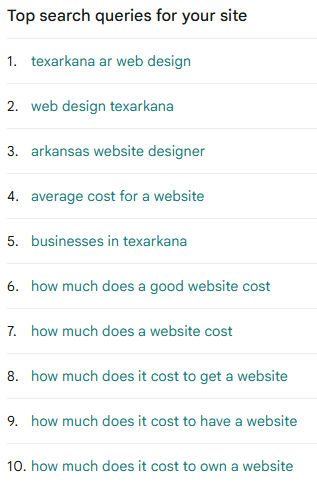
For example, on my own website, I might create a page like this one—focused on “how much does/should a website cost”—so I’m relevant when people search for that. (Notice that I’ve stated it both ways on the page to be an exact match for both searches.)
After adding this page, within a week, this query entered my list of top search terms for the site. (You can see this in the attached screenshot.)
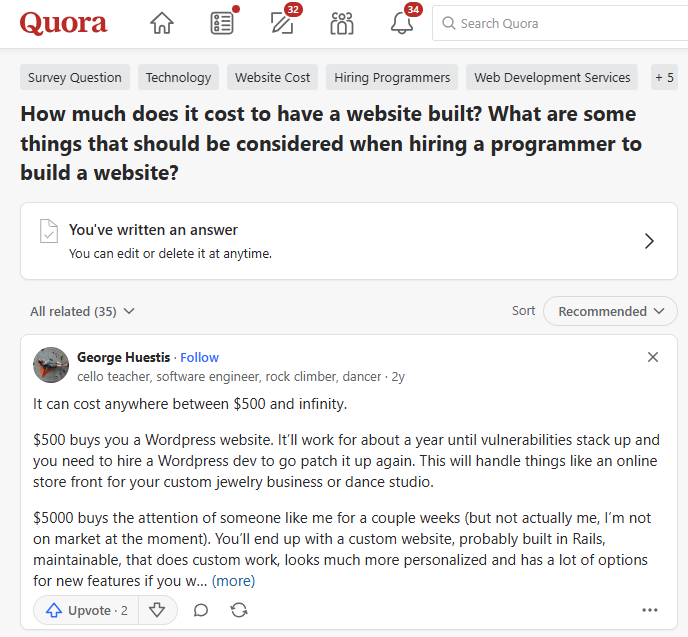
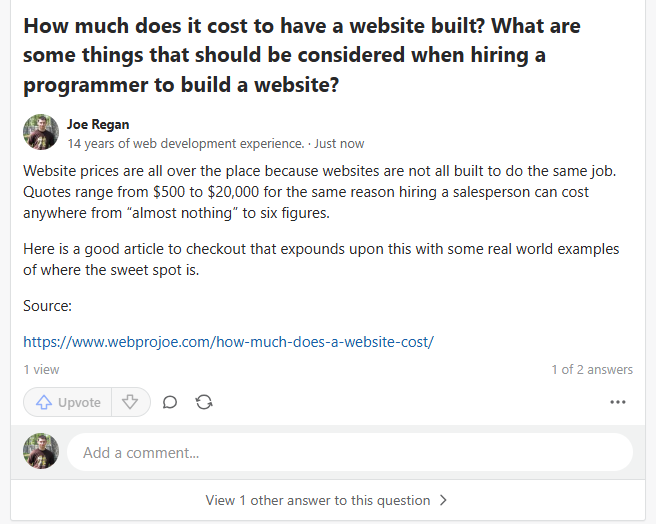
With the right partner, you’ll also receive invaluable strategic guidance. For instance, I may suggest finding places online where people are already asking the questions your website answers—or have us do it for you—and then citing your content in those discussions. This builds visibility, authority, and trust with Google.
I wouldn’t stop with a single page either. I might also build a page around “affordable website design” to reach customers specifically looking for budget-friendly options.
Or I might create a “Hot Springs AR web design” page to let people in that area know we serve their city—and often outperform agencies physically located there, even without a local office.
Every page I create is intentional. Every page has a purpose. Over time, those pages compound—driving more traffic, more leads, and more business.
Most web designers don’t think this way. Many will simply say who you are and what you do, then call it finished. In fact, many websites still use a title tag that’s nothing more than their brand name, when it should be targeting people who aren’t already searching for that brand.

Why Monthly Packages Make Sense
Growing your online presence means constantly adding new pages, refining existing ones, and improving how your content performs. When monthly task requests are included in your website plan, you can do this without hesitation.
There’s no need to cringe before making updates. No need to check the company bank account or ask for approval to invest a little more. Growth is already built in.
Instead, the focus stays where it should be:
What else can we say? How should we say it? And how can we improve our bottom line?
What about Wix or DIY options?
You might look at platforms like Wix and think, “Why not just do it myself for cheaper?” And you absolutely can. But here’s what you’re not getting:
- 20 years of experience knowing what works and what doesn’t
- Tools that show us what people are already searching for and what is already working for your competitors.
- Ongoing updates and optimization to keep your site performing
- Someone who cares about your results, long term, not just checking a box so they can work with someone else.
When you pay $200, $300, or $400 per month, you’re not just getting a website—you’re getting a partner who’s invested in your success long term. Someone who understands that a website isn’t a “set it and forget it” project, but a living tool that needs attention and strategy to deliver results.


The Bottom Line
A cheap website might save you money upfront, but if it’s not bringing in customers, it’s actually costing you money in lost opportunities. The question isn’t, what is the average cost of a website? It’s, what should my website cost?
A website built with strategy, experience, and ongoing support? That’s an investment that pays for itself—month after month, year after year.
So when you’re asking “how much should a website cost,” the real question is:
How much is it worth to have a website that actually works for your business?
If you’re ready to invest in a website that drives real results, let’s talk.
Ready to Upgrade Your Website?
If your website isn’t bringing in the traffic it needs from Google, looks outdated, loads slowly, and just doesn’t bring in leads because it doesn’t sell your products or services with the strategy they deserve, it’s time for an upgrade. Let’s build a website that represents your brand professionally and helps grow your business.
👉 View our Packages or Contact WebProJoe today to get started.